

In the fast-paced world of cryptocurrency, margin lending and borrowing are popular tools for traders who want to amplify their potential gains—or hedge against losses. While this strategy opens the door to greater profits, it also invites significant tax complexities that many investors overlook.
In this article, we’ll break down what crypto margin lending and borrowing are, how they work, and most importantly, how they’re taxed in the United States. We’ll also cover some key strategies to help you stay compliant while minimizing your tax liability.
What Is Crypto Margin Lending and Borrowing?
Let’s start with a simplified explanation.
Margin Borrowing
Margin borrowing is when you borrow crypto (or stablecoins) from an exchange or lending platform, often using your existing crypto as collateral. You use these borrowed funds to trade or invest with leverage—essentially amplifying your buying power.
Example: You deposit $10,000 worth of Bitcoin on a platform like Binance, then borrow an additional $10,000 in USDT to double your trading position.
Margin Lending
On the flip side, margin lending allows you to lend your crypto to other users (or to the platform), earning interest in return. Your funds are typically used by margin traders looking to borrow, and you're rewarded for the risk you're taking by providing liquidity.
Example: You lend your ETH on Aave or Compound and earn 3% APY paid in the same or a different token.
So far, so good? But here’s where taxes enter the picture.

Tax Classification: Is It Income, Capital Gain, or Something Else?
Crypto tax laws are still evolving, but the IRS has provided enough guidance to help classify most margin-related transactions.
Let’s examine the two sides:
1. Taxation of Margin Lending (Lenders)
If you're a lender, you're typically earning interest income, not capital gains.
🔹 Interest Income
The IRS views the yield from lending as ordinary income, similar to earning interest from a savings account or dividends from a stock. This applies whether you’re paid in fiat, stablecoins, or other cryptocurrencies.
Taxable Event: The moment you receive the interest, it's taxable—even if you don’t convert it to USD.
🔹 Reporting Requirement
Form 1040, Schedule B: Report interest earned.
Keep records of:
The amount earned
Date of receipt
Market value at time of receipt (in USD)
🔹 Additional Considerations
If you're receiving platform tokens or reward tokens (like COMP or AAVE), the value of those tokens at the time of receipt is also taxable as income.
If you later sell those tokens, you may owe capital gains tax based on how their value has changed.

2. Taxation of Margin Borrowing (Borrowers)
Borrowing crypto by itself is not taxable. But what you do with those borrowed funds can create taxable events.
🔸 Using Borrowed Crypto to Trade
If you trade with borrowed assets, those trades are taxable just like normal crypto transactions.
Example: You borrow 1 ETH and trade it for 1000 USDT. That’s a taxable event—even though you borrowed the ETH.
🔸 Loan Repayments
Repaying the loan does not trigger a taxable event, unless the crypto you’re repaying has appreciated or depreciated in value.
But watch out: if you repay with a different crypto than you borrowed, or the collateral is liquidated to cover the loan, that does trigger a capital gains/loss event.
Example: You posted 0.5 BTC as collateral when BTC was $25,000. The loan defaults and is liquidated when BTC hits $30,000. You’ve now realized a $2,500 capital gain.
Margin Liquidations: Hidden Tax Traps
If your position is liquidated due to a margin call, this is treated as a disposal of property under IRS rules. That means:
You’ve sold crypto, whether or not you intended to.
You must report the gain or loss between your cost basis and the market value at liquidation.
This can blindside traders who believe margin losses are just “bad luck” but don’t realize they still need to report the tax impact.
Borrowing Costs and Deductions
So, can you deduct margin interest as an expense?
Yes, with conditions:
If you're borrowing to trade crypto as a business, you may be able to deduct the interest as a business expense under Schedule C.
If you're trading as an investor (not a business), you may be able to claim it as an investment interest expense on Schedule A, but only up to the amount of net investment income.
Important: You must itemize deductions to claim this, and you cannot deduct more than you earn in investment income.

Real-Life Example: A Borrow-Lend Cycle
Let’s walk through a full margin cycle and see how it gets taxed:
You lend 1 ETH to a DeFi protocol and earn 0.05 ETH in interest →
You report the USD value of 0.05 ETH as ordinary income.
You borrow 5000 USDT against your ETH on a centralized exchange. →
No tax yet.
You use the USDT to buy SOL and later sell it for a profit of $1000. →
You report $1000 as a capital gain.
Your ETH collateral gets liquidated due to a price drop. You originally bought it for $2000, it was liquidated at $1700. →
You report a $300 capital loss.
You later use fiat to repay the USDT loan. No tax due at this point.
Recordkeeping: Stay Audit-Proof
Crypto margin activity can get messy fast. You must track:
Original collateral and acquisition cost
Borrowed amounts and repayment dates
Interest received (and its value on the date received)
Any liquidations (and the value of the asset at that time)
Best Tools:
Koinly, or CoinTracker all support margin activity, though DeFi integrations may vary.
Manual tracking with a spreadsheet is also an option—especially for smaller portfolios or custom DeFi setups.
Tax Planning Tips
If you’re serious about crypto trading or investing, here are a few tax-saving moves:
🛡️ Use a Self-Directed IRA (SDIRA)
Borrowing/lending inside an IRA can shield gains from current taxation.
📉 Harvest Tax Losses
Use margin losses or liquidation events to offset capital gains from other trades.
🧮 FIFO vs. Specific Identification
Track your cost basis carefully. Using “specific ID” when choosing which tokens to sell can minimize capital gains.
📆 Long-Term vs. Short-Term
Holding borrowed crypto for longer than 12 months doesn’t make it long-term. Tax classification depends on your holding period for your own crypto, not borrowed assets.

Final Thoughts: Stay Smart with Leverage
Crypto margin trading and lending can amplify both your profits and your tax exposure. While borrowing isn’t inherently taxable, the actions you take with borrowed funds are. And lenders should treat their interest earnings as income from day one.
In a world of evolving DeFi protocols and centralized lending platforms, the key is to keep detailed records, understand what counts as a taxable event, and—when in doubt—consult a crypto-savvy tax advisor.
Summary Checklist
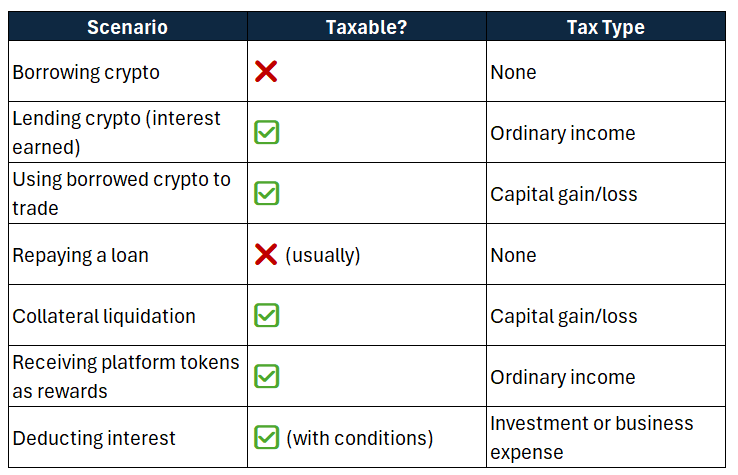
If you’re involved in margin lending or borrowing—even casually—don’t wait until tax season to sort it out. The IRS is watching, and your wallet will thank you for staying a step ahead.
DISCLAIMER: The views and opinions expressed are those of the authors and do not necessarily reflect the official policy or position of CoinFlask. Do your own research. This is not financial advice